
Eyes in the Ice –When the Mountain Gave Back a Man Part 1
Ice That Watched History History usually reaches us in fragments—broken tools, scattered bones, half-erased traces. But in 1991, high in the European Alps, history did something rare. It returned whole. Eyes in the Ice: The Discovery of a 5,000-Year-Old Man opens not with legends or guesses, but with a real moment: a human body emerging from ice after five millennia of silence. This is the story of how a frozen mountain revealed a man—and how the world slowly realized that it was staring directly into the Copper Age.
sneha shah
2/16/20263 min read
1. A Normal Hike That Wasn’t Normal
Late summer, 1991.
Two hikers were crossing a high mountain pass in the Ötztal Alps. The glacier around them was melting unusually fast, exposing dark patches beneath the ice. What caught their attention was something unmistakably human—a body, face-down, partially trapped in frozen ground.
At first glance, it looked like a tragic but modern accident.
Mountains claim lives every year.
But this body felt… wrong.
The position was unnatural
The clothing didn’t resemble modern gear
Strange objects lay nearby, half-buried
Still, no one jumped to conclusions. Authorities assumed it was a recent death and prepared for recovery.
History had other plans.
2. The Ice Begins to Speak
As rescue teams worked to free the body, they realized how deeply it was embedded in ice. This wasn’t a matter of weeks or months—it had been there for a very long time.
When archaeologists finally examined the remains, the shock was immediate.
The tools were unfamiliar.
The clothing materials were ancient.
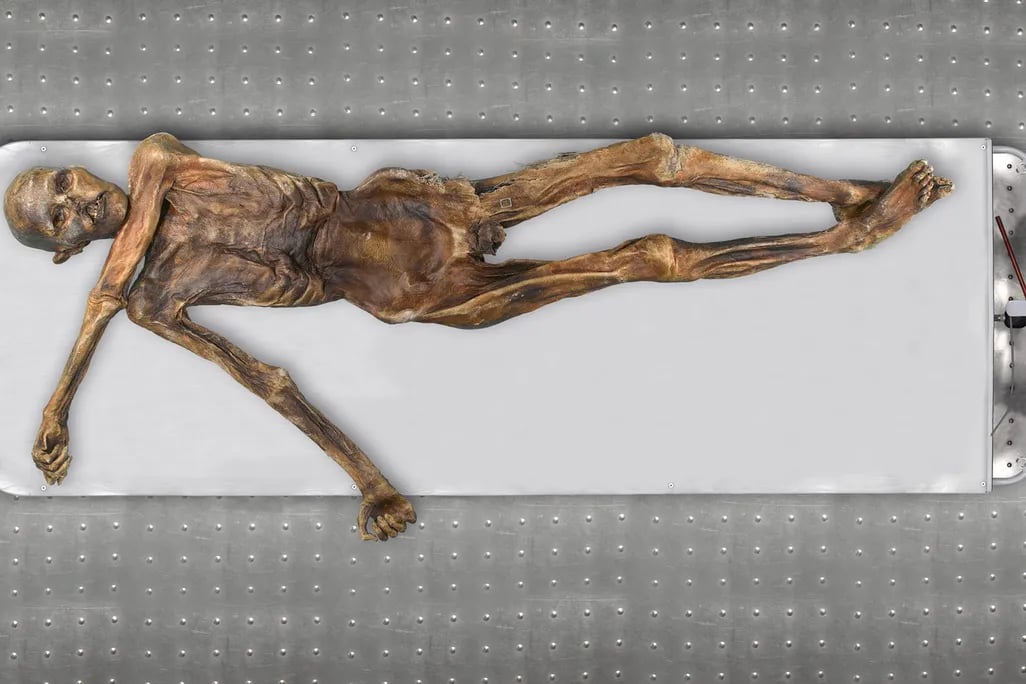
The body was preserved in a way no modern corpse could be.
This was not a lost climber.
This was a man from another world.
3. Nature’s Perfect Preservation
Unlike Egyptian mummies, this body had not been wrapped, treated, or buried with ceremony. Instead, the glacier itself had acted as a natural preservative.
The book explains this with careful detail:
Cold temperatures slowed decay
Ice sealed the body from air and bacteria
Rapid freezing preserved skin, organs, and clothing
What emerged was not a skeleton—but a complete human being, frozen at the moment of death.
This level of preservation had never been seen before in European archaeology.
4. The Moment Science Took Over
Once the possibility of antiquity was confirmed, the site transformed from a recovery operation into a scientific investigation.
Every movement became cautious.
Every object was documented.
Every fragment mattered.
The book emphasizes how easily history could have been destroyed if the body had been treated like a modern corpse. Instead, careful handling saved what would become one of the most important archaeological discoveries ever made.
This was no longer just a body.
It was evidence.
5. First Clues: Clothing and Tools
Even before laboratory tests, the items found with the body told a powerful story.
Clothes made from animal skins
Shoes designed for insulation
A backpack frame
A copper-bladed axe
Copper.
That single detail was revolutionary.
Copper tools were not supposed to exist this early—yet here one was, resting beside a man frozen for thousands of years. This discovery alone hinted that human technological history would need rewriting.
6. A Name from the Mountains
The man would later be called Ötzi, named after the Ötztal Alps where he was found. But at this stage, he was still simply the man in the ice—silent, anonymous, and astonishingly intact.
He had no grave.
No monument.
No written record.
Yet his body carried a biography written in flesh, fiber, and stone.
7. Why This Discovery Was Different
Archaeologists often work backwards from fragments. Ötzi offered something unprecedented:
A complete body
Clothing, tools, and weapons
Direct evidence of daily life
A snapshot of a single moment in time
The book makes it clear: this was not just a rare find—it was a scientific gift.
One man would reveal how people lived, traveled, worked, dressed, and survived over 5,000 years ago.
Closing of Part 1: The Past Is No Longer Distant
As Eyes in the Ice shows, the glacier did not merely uncover bones—it uncovered a story waiting to be read by science.
Part 1 ends with the world standing at the edge of a revelation.
A man had returned from deep time.
And the real investigation was only beginning.
In Part 2, science will begin to read his body—his health, his life, and the journey that led him into the mountains for the final time.